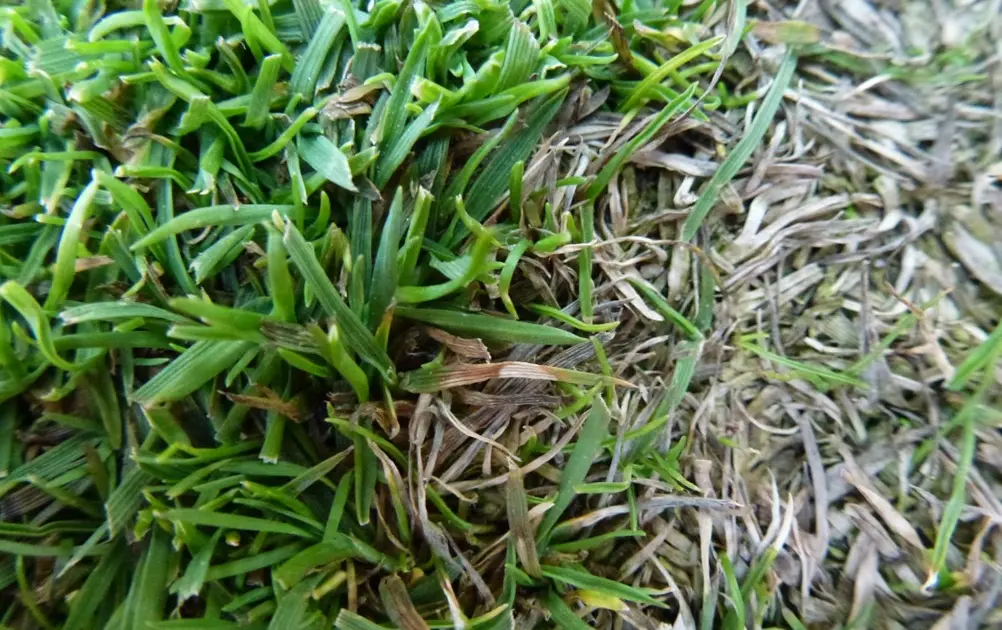
Dollar spot caused by Sclerotinia homoeocarpa fungus is a common disease on amenity turf in Australasia, North and Central America and continental Europe. During recent years, the disease has been indicated on many golf courses in Scandinavia and it was officially documented in Norway in summer 2013 (Espevig, Brurberg & Kvalbein. 2015. Plant Disease). Thus, there is need for risk assessment of dollar spot.
From July to October 2014, samples of turf with ‘dollar spot symptoms’ were collected in Sweden (16 samples from 13 golf courses), Denmark (11 samples from 7 golf courses) and Norway (2 samples from 2 golf courses), and sent to the Bioforsk Turfgrass Diagnostic Laboratory at Landvik for analysis. A fungus similar to S. homoeocarpa was isolated from 7, 4 and 1 Swedish, Danish and Norwegian golf courses, respectively (Figures 1, 2). Molecular analysis by Bioforsk Plant Health and Plant Protection showed that the S. homoeocarpa isolates from Scandinavian golf courses were divisible into two genetic groups (with 97.6% similarity between the two groups). Group 1 consisted of all Danish and most Swedish isolates, while group 2 comprised the Norwegian isolate and two Swedish isolates (Figure 2). The consensus internal transcribed region (ITS) of the ribosomal DNA of the first group was identical to ITS sequences previously reported from e.g. USA (GenBank), while the second group clearly constituted a distinct variant or maybe even a new species of Sclerotinia. In late December 2014, four isolates from cool-season grasses and two isolates from warm-season grasses were obtained from the Systematic Mycology & Microbiology Laboratory, US Department of Agriculture. These isolates represent a wide range of diversity for S. homoeocarpa. In 2015, the S. homoeocarpa isolates from USA will be sequenced and compared with those from Scandinavia.
In June 2014, a third-year BSc student (Anita Ejderdun) at the University of Gävle began her degree project on dollar spot disease. Among the objectives of her study are to define cardinal pathogenicity conditions of Scandinavian isolates of S. homoeocarpa. She obtained four isolates of S. homoeocarpa from Bioforsk Turfgrass Diagnostic Laboratory (one from Sweden, two from Denmark and one from Norway) and tested their pathogenicity at 6, 15 and 24 °C. The experiment has been run twice with creeping bentgrass plants collected from golf greens at Söderby golf club, Uppsala, and Gävle golf club, Gävle. In spring 2015, Anita will complete the data analyses and write her dissertation.